Introduction: The Role of Verification in Scientific Research
Scientific research depends on verification. Data, methods, and materials must be independently confirmed to ensure reliability and reproducibility. When it comes to research peptides, third-party testing plays a central role in validating material quality and protecting research integrity.
Without independent testing, researchers are left relying on unverified claims. This introduces unnecessary uncertainty and risk into experimental workflows. Third-party testing provides objective confirmation that a peptide matches its stated identity and purity.
What Is Third-Party Testing?
Third-party testing refers to analytical testing performed by an independent laboratory that is not affiliated with the peptide supplier. These laboratories specialize in chemical analysis and use validated methods to evaluate peptide samples.
Because the testing entity has no financial interest in the sale of the product, third-party testing provides an unbiased assessment of quality. This independence is what makes third-party verification meaningful in research contexts.
Why Independent Testing Is Essential for Research Peptides
Peptides are synthesized compounds, and even small variations in synthesis or purification can impact experimental outcomes. Independent testing helps ensure that what is delivered matches what is advertised.
Third-party testing helps:
- Confirm peptide identity
- Verify purity percentages
- Detect synthesis byproducts
- Reduce batch-to-batch variability
This verification supports consistent and reproducible research results.
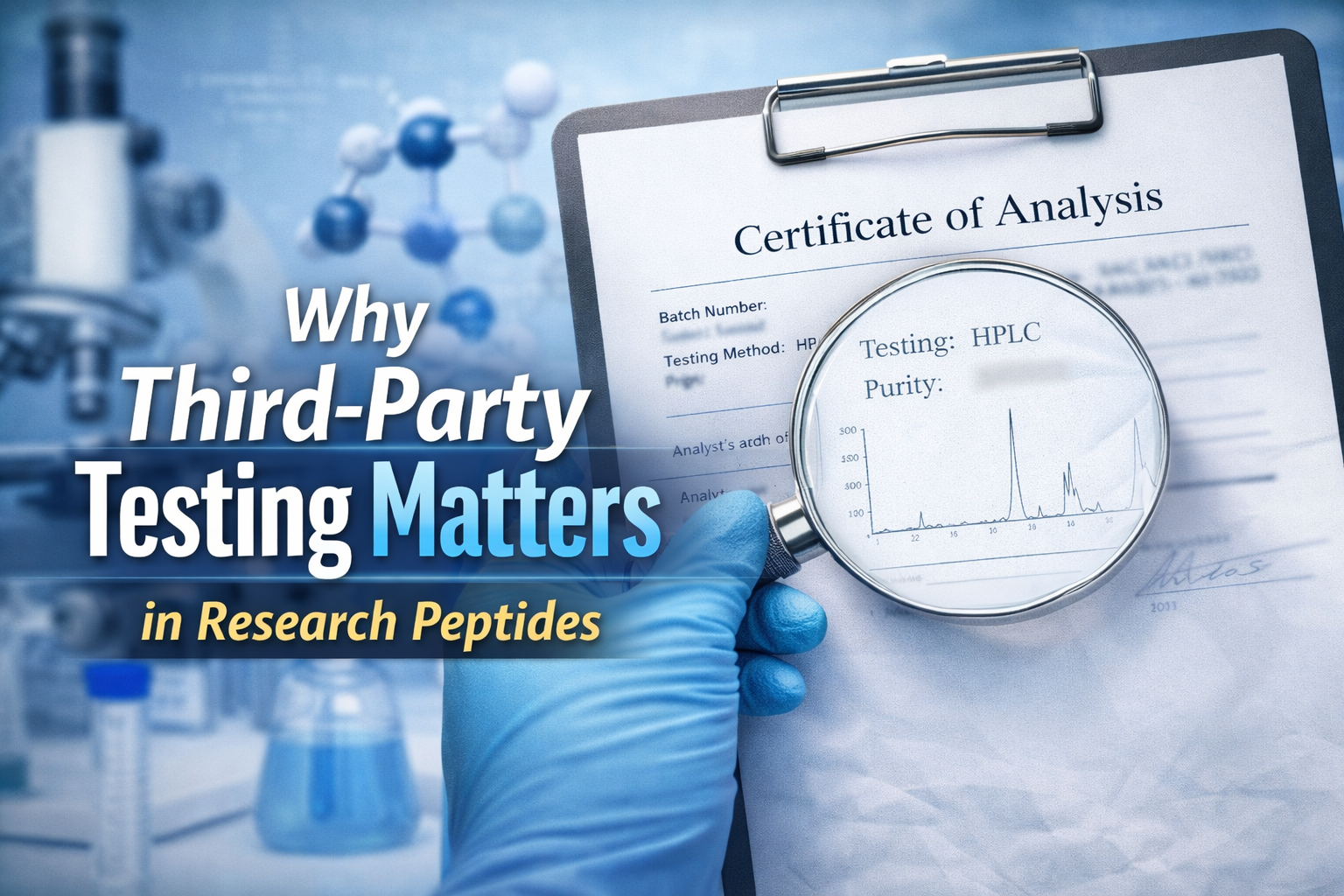
Understanding Certificates of Analysis (COAs)
A Certificate of Analysis (COA) is a formal document produced by an independent laboratory after testing a specific batch of material. COAs are a cornerstone of transparency in research peptide sourcing.
A typical COA includes:
- Peptide name and identification
- Purity percentage
- Analytical method used (e.g., HPLC)
- Batch or lot number
- Date of analysis
Researchers should always review COAs before using peptides in experiments.
How Peptide Purity Is Verified
Peptide purity is most commonly measured using High-Performance Liquid Chromatography (HPLC). HPLC separates components of a sample and allows analysts to quantify the proportion of the target peptide relative to impurities.
While HPLC is highly effective, it is important to understand that no analytical method can guarantee absolute purity. Reputable laboratories report realistic purity ranges rather than exaggerated claims.
Why “In-House Testing” Is Not Enough
Some suppliers reference internal or in-house testing without providing independent verification. While internal testing may be part of quality control, it does not replace third-party analysis.
Independent testing:
- Eliminates bias
- Increases accountability
- Enhances researcher confidence
Suppliers that rely solely on internal testing should be evaluated carefully.
Batch-Specific Testing and Traceability
High-quality research peptide suppliers test each production batch and provide batch-specific COAs. This ensures that purity and identity are verified for the exact material being sold.
Batch traceability allows researchers to:
- Reference specific materials in documentation
- Replicate experiments accurately
- Investigate discrepancies if they arise
Without batch-specific testing, consistency over time is difficult to guarantee.
How Third-Party Testing Reduces Experimental Risk
Using unverified materials introduces uncertainty into research. Impurities or misidentified compounds can affect binding behavior, reaction kinetics, and analytical results.
Third-party testing reduces risk by:
- Confirming material composition
- Supporting reproducibility
- Providing documentation for audits or reviews
Reliable materials are essential for credible scientific work.
Evaluating the Quality of a COA
Not all COAs are created equal. Researchers should look for:
- Clear testing methodology
- Legible analytical data
- Matching batch or lot numbers
- Recent testing dates
COAs should be specific, transparent, and easy to interpret.
Why Ethical Suppliers Make COAs Accessible
Reputable research-only suppliers view COAs as essential documentation, not marketing tools. Making COAs accessible demonstrates confidence in product quality and respect for researchers.
Suppliers that withhold or obscure testing data often lack accountability.
JP Peptides’ Commitment to Third-Party Testing
At JP Peptides, third-party testing is a foundational quality standard. We emphasize:
- Independent laboratory verification
- Batch-specific Certificates of Analysis
- Transparent documentation
- Ethical research-only compliance
Our goal is to provide researchers with dependable materials backed by objective testing.
Third-Party Testing and Responsible Research
Responsible research requires verified materials. Third-party testing supports:
- Scientific integrity
- Regulatory compliance
- Long-term research sustainability
By prioritizing independent verification, researchers protect the credibility of their work.
Conclusion
Third-party testing is not optional in serious peptide research — it is essential. Independent verification confirms identity, purity, and consistency while reducing experimental risk.
Researchers who prioritize suppliers with transparent third-party testing practices set the foundation for accurate, reproducible scientific research.
We’re committed to quality, reliability, and your satisfaction—making every shopping experience easy, convenient, and trustworthy.
— Emma Larson